| The Amazing Lives of Stationary Animals |
As many of you know all too well, it can take effort to get up and move. You get up and move to
use the bathroom, you get up and move to eat...sometimes you even have to get up and move
to reproduce! While most of the animal kingdom shares your pain, there are many in the
evolutionary race who have narrowly evaded the hornet's nest that is mobility. These creatures,
known to science as "sessile," spend their entire adult lives firmly attached to a single place.
It should come as no surprise that all of our candidates for the most exciting sessile animals
happen to dwell in the ocean, where even the most slothful creature can open its mouth and
receive a steady stream of food on the water's current. On dry land, such behavior is mirrored
only by the females of certain insects, which live attached to plant life under a waxy shell.
use the bathroom, you get up and move to eat...sometimes you even have to get up and move
to reproduce! While most of the animal kingdom shares your pain, there are many in the
evolutionary race who have narrowly evaded the hornet's nest that is mobility. These creatures,
known to science as "sessile," spend their entire adult lives firmly attached to a single place.
It should come as no surprise that all of our candidates for the most exciting sessile animals
happen to dwell in the ocean, where even the most slothful creature can open its mouth and
receive a steady stream of food on the water's current. On dry land, such behavior is mirrored
only by the females of certain insects, which live attached to plant life under a waxy shell.
| #6: Carnivorous Sea-Sponge |
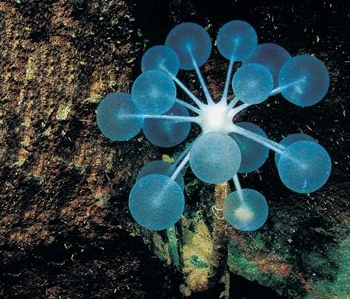
A flesh-eating beast you are unlikely to find in a pineapple, the surface of this innocuous-looking
deep-sea organism functions as a sort of flypaper for small crustaceans, entangling their jointed
limbs in a velcro-like pattern of microscopic hooks. Special cells in the sponge's body migrate
around the prey to form a temporary orifice, where its lipid content is absorbed and carried to
the sponge's core.
Many other sponges feed in a similar fashion, but Chondrochladia lampadiglobus, pictured here,
is one of the most visually striking. Nearly all are found in the deep-sea abyss, arctic waters and
underwater caves where sunlight and plankton are relatively scarce.
deep-sea organism functions as a sort of flypaper for small crustaceans, entangling their jointed
limbs in a velcro-like pattern of microscopic hooks. Special cells in the sponge's body migrate
around the prey to form a temporary orifice, where its lipid content is absorbed and carried to
the sponge's core.
Many other sponges feed in a similar fashion, but Chondrochladia lampadiglobus, pictured here,
is one of the most visually striking. Nearly all are found in the deep-sea abyss, arctic waters and
underwater caves where sunlight and plankton are relatively scarce.
| #4: Barnacles |
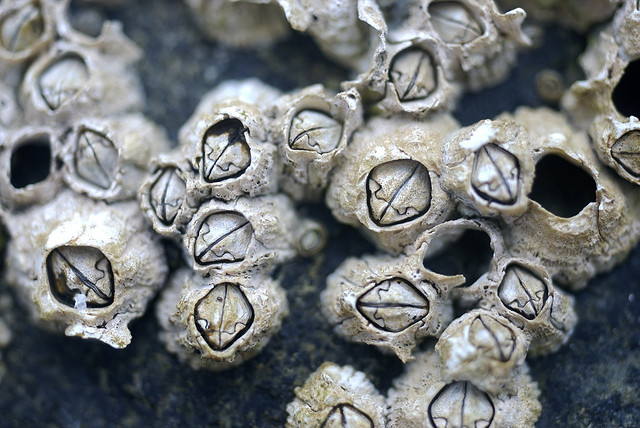
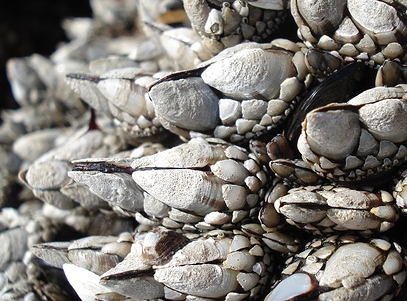
I was tempted to write something about the parasitic barnacle, Sacculina, which discards 90% of
its body to become an infection that castrates crabs, but I decided after much deliberation that it
didn't qualify for this list because it only anchors itself to a mobile host. By contrast, these acorn
barnacles, the quintessential sessile animal, have little regard for what they attach to so long as
they can spend at least a portion of each day submerged in water.
Related to crabs, lobsters and shrimps in the subphylum Crustacea, a barnacle begins its life as
a one-eyed, swimming larva known as a Nauplius. After several molts, the Nauplius develops into
a more heavily armored "Cyprid," with large antenna for seeking out others of its kind. On finding
a suitable spot in the nearest barnacle encampment, it secretes an adhesive substance from the
antenna and attaches itself upside-down, to spend the remainder of its life sweeping plankton
into its mouth with its feathery legs.
While many sessile animals mate by releasing eggs and sperm into the surrounding water,
barnacles take a more direct approach by fertilizing neighbors with an incredibly long, prehensile
penis, proportionately the largest in the known animal kingdom. Unusual for a crustacean, these
creatures are hermaphrodites, each individual capable of bearing young.
its body to become an infection that castrates crabs, but I decided after much deliberation that it
didn't qualify for this list because it only anchors itself to a mobile host. By contrast, these acorn
barnacles, the quintessential sessile animal, have little regard for what they attach to so long as
they can spend at least a portion of each day submerged in water.
Related to crabs, lobsters and shrimps in the subphylum Crustacea, a barnacle begins its life as
a one-eyed, swimming larva known as a Nauplius. After several molts, the Nauplius develops into
a more heavily armored "Cyprid," with large antenna for seeking out others of its kind. On finding
a suitable spot in the nearest barnacle encampment, it secretes an adhesive substance from the
antenna and attaches itself upside-down, to spend the remainder of its life sweeping plankton
into its mouth with its feathery legs.
While many sessile animals mate by releasing eggs and sperm into the surrounding water,
barnacles take a more direct approach by fertilizing neighbors with an incredibly long, prehensile
penis, proportionately the largest in the known animal kingdom. Unusual for a crustacean, these
creatures are hermaphrodites, each individual capable of bearing young.
| #3: Predatory Tunicates |
Tunicates, or "sea squirts," are considered among the most unusual animals alive today. In its
swimming, tadpole-like larval state, a sea squirt possesses both a rudimentary brain and a
primitive "backbone" called a notochord, placing them alongside vertebrates like ourselves in the
phylum Chordata. This symbol of kinship is often short-lived, however, as most sea squirts
spend their larval stage, much like barnacles, looking for a permanent place to settle down, and
will proceed to digest both the "brain" and "spine" as they develop into little more than a rubbery,
filter-feeding bag of skin.
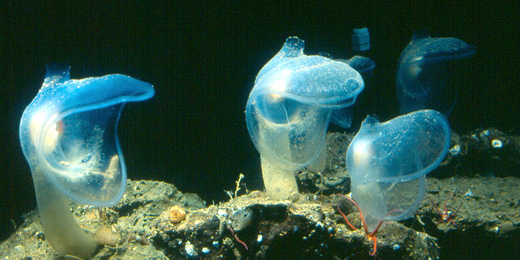
Though the entire group is pretty damn fascinating, the species Megalodicopia hians kicks the
action up a notch with an appetite for more than just microscopic plankton. Standing like a
sinister satellite dish in the abyssal current, it waits for tiny animals to blunder their way into its
deceptively adorable giant mouth, closing over and digesting them in the fine tradition of the
Venus fly-trap.
swimming, tadpole-like larval state, a sea squirt possesses both a rudimentary brain and a
primitive "backbone" called a notochord, placing them alongside vertebrates like ourselves in the
phylum Chordata. This symbol of kinship is often short-lived, however, as most sea squirts
spend their larval stage, much like barnacles, looking for a permanent place to settle down, and
will proceed to digest both the "brain" and "spine" as they develop into little more than a rubbery,
filter-feeding bag of skin.
Though the entire group is pretty damn fascinating, the species Megalodicopia hians kicks the
action up a notch with an appetite for more than just microscopic plankton. Standing like a
sinister satellite dish in the abyssal current, it waits for tiny animals to blunder their way into its
deceptively adorable giant mouth, closing over and digesting them in the fine tradition of the
Venus fly-trap.
| #2: Hydrothermal Tube-Worms |
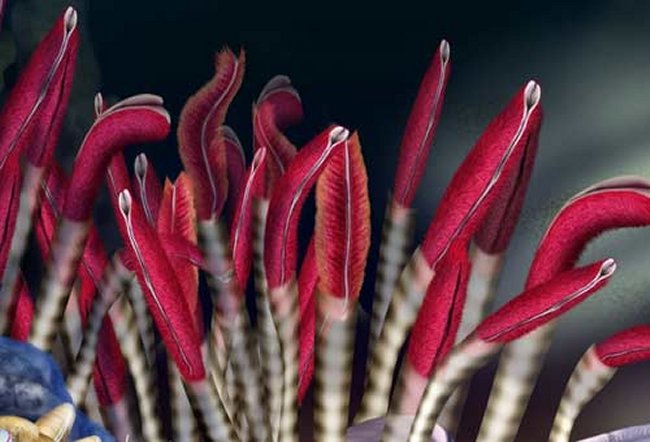
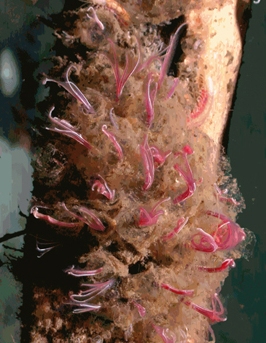
When volcanic activity deep beneath the Earth's crust forces superheated water up through the
sea floor, the result is a hydrothermal vent or "black smoker;" an underwater geyser spewing
clouds of boiling-hot, toxic minerals that would be instantly lethal to most of Earth's organisms.
Not so for certain species of giant tube-worm, which not only thrive in this alien environment but
have been known to reach nearly ten feet in length; thousands of times larger than their
filter-feeding cousins in shallower, more hospitable waters. Lacking a digestive system, these
worms feed through a process known as chemosynthesis, where bacteria in the animal's body
feed off raw materials such as carbon monoxide, hydrogen sulfide, oxygen and methane,
producing particles of organic waste that provide the worm's cells with all the energy they need.
sea floor, the result is a hydrothermal vent or "black smoker;" an underwater geyser spewing
clouds of boiling-hot, toxic minerals that would be instantly lethal to most of Earth's organisms.
Not so for certain species of giant tube-worm, which not only thrive in this alien environment but
have been known to reach nearly ten feet in length; thousands of times larger than their
filter-feeding cousins in shallower, more hospitable waters. Lacking a digestive system, these
worms feed through a process known as chemosynthesis, where bacteria in the animal's body
feed off raw materials such as carbon monoxide, hydrogen sulfide, oxygen and methane,
producing particles of organic waste that provide the worm's cells with all the energy they need.
| #1: Osedax worms |
As the largest single concentration of meat in the animal kingdom, the death of a whale is one of
the deep sea's most celebrated events. The titanic carcass can take months or even years to
completely decompose, and becomes a veritable cornucopia of new life as thousands of animals
flock to the free buffet - some of which have evolved to feed on absolutely nothing else.
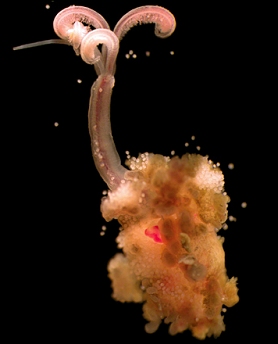
Stripped of most flesh by squirming hordes of hagfish and ghostly white crustacea, a fallen
leviathan's monolithic skeleton soon comes alive with a tentacled bouqet of bizarre organisms
known to some researchers as "zombie worms," "bone eaters" and "snot flowers". Structured more
like a plant than an animal, the female Osedax worm lacks a mouth or stomach, relying on a
network of "roots" to tap into its only food source, the fatty oils contained within whale bone. Like
the thermal tube worms, it relies on unique symbiotic bacteria to process this nourishment.
When Osedax were first discovered as recently as 2002, biologists were perplexed by the
appearance of only female reproductive organs in every mature specimen, despite the presence of
male sperm and millions of fertile eggs. As it turned out, the "missing" male worms were there all
along, plentiful but microscopic, living inside the bodies of the females. Continuously fertilized by
her tiny inner harem, the lady snot-flower pumps thousands of eggs into the surrounding water, to
drift like dandelion seeds until another colossal corpse appears on the sea floor.
the deep sea's most celebrated events. The titanic carcass can take months or even years to
completely decompose, and becomes a veritable cornucopia of new life as thousands of animals
flock to the free buffet - some of which have evolved to feed on absolutely nothing else.
Stripped of most flesh by squirming hordes of hagfish and ghostly white crustacea, a fallen
leviathan's monolithic skeleton soon comes alive with a tentacled bouqet of bizarre organisms
known to some researchers as "zombie worms," "bone eaters" and "snot flowers". Structured more
like a plant than an animal, the female Osedax worm lacks a mouth or stomach, relying on a
network of "roots" to tap into its only food source, the fatty oils contained within whale bone. Like
the thermal tube worms, it relies on unique symbiotic bacteria to process this nourishment.
When Osedax were first discovered as recently as 2002, biologists were perplexed by the
appearance of only female reproductive organs in every mature specimen, despite the presence of
male sperm and millions of fertile eggs. As it turned out, the "missing" male worms were there all
along, plentiful but microscopic, living inside the bodies of the females. Continuously fertilized by
her tiny inner harem, the lady snot-flower pumps thousands of eggs into the surrounding water, to
drift like dandelion seeds until another colossal corpse appears on the sea floor.
| Photo by MBARI |
| Photo by modomatic |
| photo by Michelle Kroll |
| photo by Ben Amstutz |
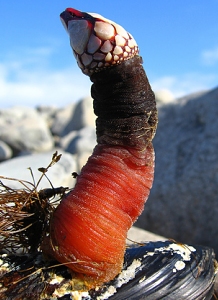
While some barnacles grow in an iconic, volcano-like "acorn" shape, many more are
referred to as "goose-necked" for their beak-like shell and soft, flexible stem. In olden times
(you know, the times of olden. Whenever that was.) it was even believed by some
"naturalists" that these creatures became geese at maturity.
referred to as "goose-necked" for their beak-like shell and soft, flexible stem. In olden times
(you know, the times of olden. Whenever that was.) it was even believed by some
"naturalists" that these creatures became geese at maturity.
Interestingly, sessile animals such as these are not without their cheaters. After all that
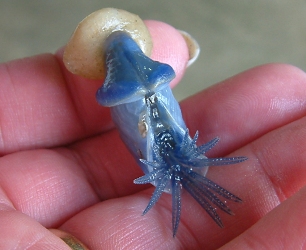
adapting away from mobility, some barnacle species have developed a spongy "float" and
simply surf the currents. These "buoy" barnacles often cluster together in larger groups,
and may even be colonized in turn by their less mobile relatives!
adapting away from mobility, some barnacle species have developed a spongy "float" and
simply surf the currents. These "buoy" barnacles often cluster together in larger groups,
and may even be colonized in turn by their less mobile relatives!


| Photo from the Monterey Bay Aquarium |

In 2009, a brand new species of carnivorous tunicate was confirmed to dwell in
deep Tasmanian waters. As you can see, this variety chooses an entirely
different "mouth" shape, considerably less anthropomorphic but no less
fascinating.
deep Tasmanian waters. As you can see, this variety chooses an entirely
different "mouth" shape, considerably less anthropomorphic but no less
fascinating.