Written by Jonathan Wojcik
OCTOBER 24: SKILEVAKS!
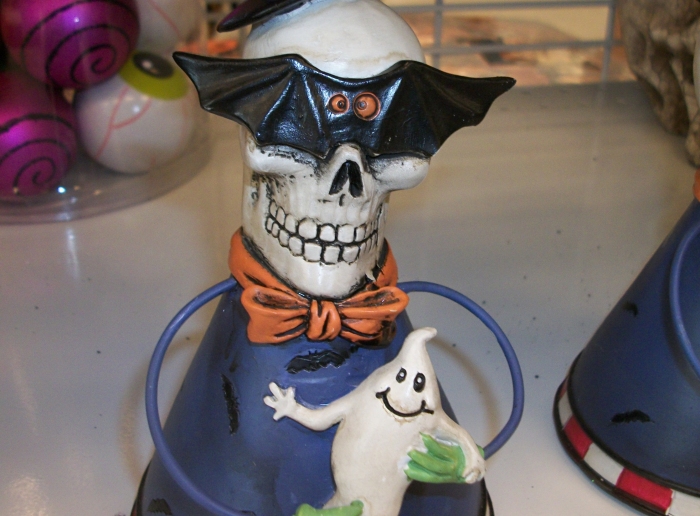
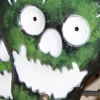
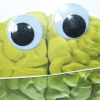
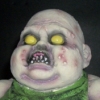
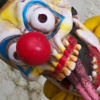
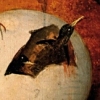
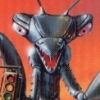
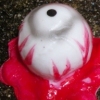
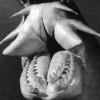
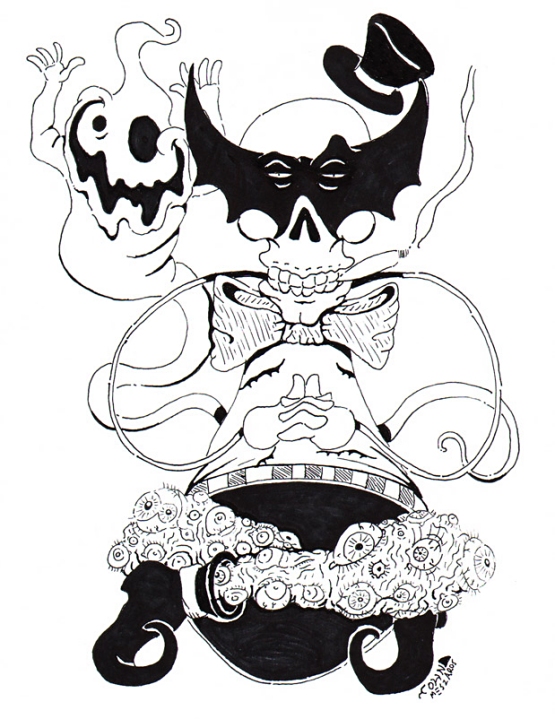
On the 21st, I introduced you all to what I spontaneously decided was called a Skilevak for some reason. Having realized the unique treasure I allowed to slip by, I've since been to every "Ross" I can think of within reasonable driving distance, but not one remains for sale. Fortunately, the internet knows exactly the dumb ways to make me feel better, because in only about a day, my request for Skilevak D&D stats was filled twice and at least three different people drew beautiful fan art!

Skilevak Pathfinder Stats by James Morgana:
CR 12
Chaotic Neutral Medium Undead
Init: +6 Senses: Lifesense 60' (Su), All around vision (Ex), Darkvision 30', Perception +
Aura: Unnatural 30' (animals do not willingly approach the creature unless the animal's master makes a DC 25 Handle Animal, Ride, or wild empathy check)
DEFENSE:
AC 17, touch 13, flat-footed 14 (+4 Armor, +3 Dex)
HP 64 (8D8+32)
FORT +6, REF +5, WILL +8
Immune: Undead Traits (Ex)
OFFENSE:
Speed: 20', 40' Fly (Average maneuverability)
Melee: Two slam attacks (+5/+0 melee, 1D6-1 Bludgeoning)
Ranged: Ray of Frost (+9 ranged touch, 1D3 cold damage)
Special Attacks: Confusing gaze (Will DC 20 or Will DC 15 if subject passes Knowledge(Religion) or Monster Lore check at DC 20)
Spell-Like Abilities (CL 8th)
Constant - Detect Magic, Mage Armor
At Will - Ray of Frost, Mage Hand, Open/Close
3/Day - Corrosive Touch (+5 touch attack, 5D4 acid damage), Shield (not factored into AC)
1/Day - Summon Spectre
STATISTICS:
STR 8, DEX 16, CON -, Int 12, Wis 15, Cha 18
Base Attack +6/+1, CMB +5, CMD 18 (cannot be tripped)
Feats: Improved Initiative, Acrobatic, Skill Focus (Perception), Ability Focus (Gaze)
Skills: Acrobatics +9, Fly +16, Knowledge (Arcana) +8, Perception +19, Sense Motive +13, Spellcraft +12(Arcana) +(4 ranks +1 int +3 class), Perception + (8 ranks +2 wis +3 class +4 racial), Sense Motive + (8 ranks +2 wis +3 class), Spellcraft + (8 ranks +1 int +3 class)
Languages: Common, plus one randomly generated language
SPECIAL ABILITIES:
All-Around Vision (Ex): The floating eyeballs which serve as a Skilevak's legs allow it to see in all directions. Skilevacs gain a +4 racial bonus to Perception checks and cannot be flanked.
Lifesense (Su): While the Skilevak's floating eyeball legs are its primary source of sight, the symbiotic bat which spends most of its time attached to its face provides lifesense so long as the bat remains attached. This is lost whenever the Skilevak uses the bat to attack or if the bat is forcibly removed (DC 18 strength check).
Bat (Ex): As a move action a Skilevak can willingly detach the bat affixed to its face, losing it's own lifesense ability in doing so. Treat the bat as a bat familiar equivalent to Witch level 8 (the Skilevac can use this bat to deliver its spell-like abilities). The bat may re-attach as a swift action so long as it is within the Skilevak's space.
Summon Spectre (Su): By spending a full-action, the Skilevak may summon 1D3 spectres which act immediately after being summoned. They will remain until either they or the Skilevak that summoned them are destroyed, or until dispelled by the Skilevak. These are normal spectres as listed in Bestiary I, with the exception that they lack the ability to create spawn.
Gaze (Su): Making eye contact with any part of the Skilevak is maddenning to even the most jaded of adventurers. All those within 30' of a Skilevac must make a Will save (DC 20) or be dazed. A Skilevak may also choose to focus its gaze at a specific target as an attack action so long as it's symbiotic bat is affixed to its face, which must make a Will save (DC 20) or be confused for 1D4+1 rounds. In this way it is possible for an opponent to save against the Skilevac's gaze twice during the same round, once before the opponent’s action and once during the creature’s turn. To determine a confused opponent's behavior, roll percentile dice and consult the chart below:
01 - 25: Act normally
26 - 50: Do nothing but babble incoherently
51 - 75: Deal 1D8 points of damage + Str modifier to self with item in hand
76 - 100: Attack nearest creature (for this purpose, a familiar counts as part of the subject's self)
A savvy adventurer can attempt to make a Knowledge(Religion) or Monster Lore check (DC 20) to discover that speaking the Skilevak's name thrice backwards will end the confusion or daze effect. Speaking the Skilvak's name backwards is no easy feat, however, so this reduces the Will save DC to 15.

Art by Spookums!
Skilevak (Soulbrooder) by Demiurge:
This grotesque creature looms as tall as an ogre, its upper body appearing as a skeletally-thin humanoid figure. Its face is shrouded by a ragged piece of skin shaped like a pair of membranous wings, from which glare burning orange orbs. Below the waist, two fat tentacles grow, each of them studded with dozens of lidless eyes. It is clad in a motley of garishly colored fabric, tailored into a crude costume.
CR 10
XP 9,600
LE Large aberration
Init +5; Senses all-around vision, darkvision 60 ft., Perception +17
Defense
AC 24, touch 10, flat-footed 23 (-1 size, +1 Dex, +14 natural)
HP 126 (12d8+72)
FORT +12, REF +5, WILL +12
DR 10/silver; Defensive Abilities negative energy affinity
Offense
Speed 30 ft., climb 20 ft.
Melee 2 claws +14 (1d8+6), 2 tentacles +13 (2d6+3 plus grab)
Ranged eyebat +9 ranged touch (attach)
Space 10 ft.; Reach 10 ft.
Special Attacks constitution drain, constrict (2d6+9), create spawn, gaze
Statistics
STR 22, DEX 13, CON 23, Int 13, Wis 14, Cha 16
Base Atk +9; CMB +16 (+20 grapple); CMD 27
Feats Great Fortitude, Improved Initiative, Iron Will, Multiattack, Skill Focus (Stealth), Weapon Focus (tentacle)
Skills Climb +14, Craft (sewing) +13, Knowledge (dungeoneering) +16, Knowledge (religion) +13, Perception +17, Stealth +18
Languages Aklo, Undercommon
SQ eyebat, grisly feast
Ecology
Environment underground
Organization solitary or family (1 plus 1-6 wraiths)
Treasure standard
Special Abilities
Attach (Ex) If a skilevak’s eyebat hits an opponent, it latches on with its entire body. An attached eyebat is effectively grappling its prey with a CMB equal to the skilevak’s modified for size, with a +8 bonus on all CMB checks made to maintain the grapple (CMB +21 for a typical skilevak). An eyebat loses its Dexterity bonus to AC when attached. A successful CMB check or Escape Artist check allows a grabbed foe to escape, as normal.
Constitution Drain (Su) An attached eyebat deals 1d4 points of Constitution drain each round it remains attached.
Create Spawn (Su) A humanoid creature slain by a skilevak’s Constitution drain is animated as a wraith 1d6 minutes after it dies. Wraiths created by a skilevak remain under the skilevak’s control until its death.
Eyebat (Ex/Su) As a move action, a skilevak can detach the bat-like flap of skin covering its face. The skilevak can then move the eyebat up to 30 feet a round as a swift action. An eyebat is treated as being a Tiny creature with an AC of 20, touch 13, flat-footed 19, hit points equal to 1/5th of the skilevak’s total hit points (25 for a typical skilevak) with the saving throws and skills of the skilevak. An eyebat flies with perfect maneuverability (Fly +17). A skilevak can see through the eyebat as per an arcane eye spell—this ability is supernatural and does not occur in the area of an antimagic field or similar effect. If an eyebat enters a creature’s space, it can attempt to attach itself to that creature.
An eyebat can reattach to a skilevak sharing its space as a move action. If a skilevak’s eyebat is slain, the skilevak is sickened for 1 week, until it grows a new eyebat.
Gaze (Su) Stunned 1 round, range 30 feet, Fort DC 19 negates. The save DC is Constitution based.
Grisly Feast (Su) A skilevak that reattaches to its eyebat gains 5 temporary hit points for each point of Constitution drained by the eyebat since it was detached.
Negative Energy Affinity (Ex) Skilevaks are treated as undead for the purposes of positive and negative energy effects.
Referred to as “soulbrooders” by sages, skilevaks are bizarre aberrant creatures that nurture the incorporeal undead as if they were beloved children. The form of a skilevak is extremely unusual, most notably in terms of the “eyebat”, a detachable lump of flesh that serves as a skilevak’s primary means of feeding. A skilevak will use its eyebat to seek out prey which it then mesmerizes with its gaze. The helpless victims are then drained of life by the eyebat. The victims of a skilevak rise as wraiths, serving their master as companions.
Skilevaks appear to be sexless, and their means of reproduction is unknown. Their undead spawn serve the role of children to a skilevak, who dotes upon its charges with what would be considered loving care in a more conventional parent/child relationship. A skilvelak will weaken victims so that its children can enjoy the sensation of the kill, for example. Due to their humanoid frames and the enormous empty eye socket covered by the skinbat, some sages theorize that skilevaks originated as cyclopes, mutated unspeakably by evil magic or drow fleshwarping. Possibly fitting with this theory is the skilevak’s preference for walking on the tips of its tentacles as if they were boneless legs—only when climbing or threatened does it drop into a crawling posture to better use these prehensile appendages.
Skilevaks love clothing of all kinds, and stitch together the garments of their victims into coverings for their own bodies. The promise of colorful fabrics or magical clothing is one of the few things that can prevent a skilevak attack, and the beasts are known to barter safe passage or information for particularly choice items. It is rumored by adventurers that skilevaks hate the sound of their species name and will recoil if it is spoken, but this is merely a rumor—skilevaks take great amusement in pretending to flee from the sound of its name only to circle around and renew its attack with surprise. A skilevak stands nine feet tall on tentacle-tip, but is only six feet tall when crawling. The average skilevak weighs 400 pounds.
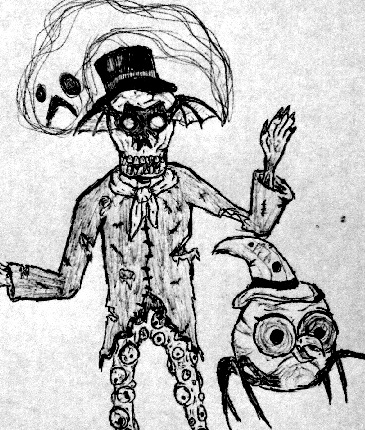
Alternate Skilevak by Chris Nichols:
"A flapping lump of flesh shaped like a bat obscures the face of this rag-clad skeletal horror. In place of legs, a glistening, rolling column of unconnected eyeballs stretches from this nightmare's pelvis to its bony feet. A shrieking cacodaemon circles overhead, and ghostly figures follow behind it."
CR 15
XP 38,400
NE Medium undead (extraplanar)
Init +7;
Senses all-around vision, darkvision 60 ft., see in darkness; Perception +22
Aura unnatural aura (30 ft.)
DEFENSE
AC - 23, touch 12, flat-footed 21 (+2 Dex, +11 natural)
HP 126 (12d8 + 72)
Fort +10, Ref +7, Will +12
Defensive Abilities channel resistance +2
DR 5/magic, good
Immune undead traits
Weaknesses daemonic servitude, secret words
OFFENSE
Speed 30 ft.
Melee 2 claws +13 (1d6 + 6 plus bleed and energy drain), bite (1d6 + 6 plus bleed and energy drain)
Special Attacks bleed (1d6), energy drain (1 level, DC 22), paralyzing gaze,
Spell-Like Abilities (CL 10th)
Constant - see alignment (good)
3/day - disfiguring touch, murderous command, silence
1/day - animate dead, desecrate
Spells Known (CL 7th)
3rd (5/day) - excruciating deformation, lesser animate dead
2nd (8/day) - darkness, detect thoughts, see invisibility
1st (8/day) - chill touch, corrosive touch, ear-piercing scream, interrogation, lock gaze
0 - bleed, daze, detect magic, message, ray of frost, read magic, touch of fatigue
STATISTICS
Str 22, Dex 16, Con -, Int 16, Wis 18, Cha 22
Base Atk +9; CMB +15; CMD 28
Feats Ability Focus (Paralyzing Gaze), Ability Focus (Face-Bat), Blind-Fight, Combat Reflexes, Improved Familiar (B), Improved Initiative, Improved Natural Attack (Claws)
Skills Knowledge (arcana) +17, Knowledge (religion) +17, Knowledge (planes) +17, Perception +22, Stealth +17, Use Magic Device +20;
Racial Modifiers +4 Perception
Languages Common, Abyssal, Infernal
ECOLOGY
Environment any land or Abaddon
Organization solitary (skilevak plus cacodaemon familiar), cult (skilevak and cacodaemon familiar plus 1-3 skilevak spawn and 2-10 ectoplasmic creatures), cabal/conspiracy (2-5 skilevaks and cacodaemon familiars plus 2-15 skilevak spawn and 10-60 ectoplasmic creatures)
Treasure NPC gear (including one item of magical clothing (Wondrous Item))
SPECIAL ABILITIES
All-Around Vision (Ex) A skilevak's eye-legs constantly squirm and rotate, allowing it to see in all directions. Skilevaks gain a +4 racial bonus to Perception checks and can not be flanked.
Bleeding Wounds (Ex) The daemons that create skilevaks sharpen the teeth and finger bones of their undead servants. This treatment allows skilevaks to deal horrible bleeding wounds to their foes. Any opponent who takes damage from a skilevak's bite or claw attacks also takes 1d6 bleed damage.
Cacodaemon Familiar (Ex) When a skilevak is created, its daemon masters bond it to a cacodaemon familiar. Skilevaks receive Improved Familiar as a bonus feat because of this bonding process.
Create Spawn (Su) A skilevak can create spawn out of humanoids it slays with its face-bat. The victim rises from death as a skilevak spawn in 2d4 hours. This spawn is under the command of the skilevak that created it, and remains enslaved until its master is destroyed or it upgraded to a true skilevak by a daemon. A skilevak may have enslaved spawn of Hit Dice totaling no more than twice its own Hit Dice; any spawn it creates that that would exceed this limit become free-willed undead. A skilevak may free an enslaved spawn in order to enslave a new spawn, but once freed, a skilevak spawn cannot be enslaved again.
Daemonic Servitude (Su) Skilevaks are created by and enslaved to daemons. They are effectively under a geas commanding them to pursue the goals of their daemon masters on the Material Plane. Should they fail to actively pursue some daemonic agenda, they suffer the penalties associated with failing to obey a geas. Additionally, if a skilevak attempts to harm a daemon (including its cacodaemon familiar), it immediately is cursed with a -20 penalty on all saves, skill checks, and attack rolls for the next 24 hours.
Ectoplasmic Summons (Su) Whenever a skilevak animates an undead creature, whether by spell-like ability, spell, magic item, or other means, the undead rises as an ectoplasmic creature (see Pathfinder Adventure Path #43: Carrion Crown - The Haunting of Harrowstone, pp. 86-87) instead of the type normally indicated.
Face-Bat (Su) As a ranged touch attack, a skilevak may launch its face-bat at an enemy. The face-bat detaches from the skilevak's skull, flying at the target and latching onto its face, blinding them for 1 round and dealing 1d4 points of Constitution damage. On the skilevak's next turn, the face-bat flies back and re-attaches to the skilevak's face, and if the face-bat inflicted Constitution damage upon its target, the skilevak heals 5 hit points or gains 5 temporary hit points for 1 hour (up to a maximum number of temporary hit points equal to its full normal points).
Paralyzing Gaze (Su) Paralyzed for 1d6+1 rounds, 30 feet, Fortitude DC 24 negates. The save DC is Charisma-based. A skilevak may target up to 4 creatures per turn with this ability.
Ragged Affinity (Su) Skilevaks have a strange affinity for items of magical clothing, such as capes, cloaks, shirts, gloves, boots, hats, and caps. When using a clothing-based wondrous item made of cloth or leather, the item's Caster Level is treated as though it were 1 level higher. Additionally, if the wondrous item is usable a limited number of times per day, a skilevak can wring 1 extra usage from it per week. All clothing, magical or mundane, becomes ragged, tattered, and caked in grave mold and dirt when worn by a skilevak.
Rejuvenation (Su) When a skilevak is created, the daemon responsible takes the skilevak's femurs and carves the skilevak's true name into them. These bones at then spirited away to Abaddon, hidden in secret ossuaries beneath the strongholds of daemonic lords. So long as these bones exist, when a skilevak is destroyed, it reforms 1d10 days later in Abaddon. The skilevak awakens in Abaddon fully healed (albeit without any gear it left behind on its old body). After a year and a day, during which time it can not leave the plane of Abaddon and is likely to be punished extensively by its daemonic masters, a skilevak may be sent back to the Material Plane. Each time a skilevak rejuvenates in this manner, one of its engraved femurs shatters, crumbles into dust, and is forever lost; thus, a skilevak can only be rejuvenated twice before it is destroyed permanently.
Secret Words (Su) The magics used by daemons to create skilevaks has a fatal flaw - the secret word "kaveliks," skilevak spelled backwards, can negate many of their abilities. If a person says this word three times in a row (a free action), they become immune to a skilevak's paralyzing gaze and face-bat drain abilities for 1d4+1 rounds. Additionally, if a skilevak hears this word repeated three times in row, they are unable to use their spells and spell-like abilities for 1d4+1 rounds.
Additionally, skilevaks can not cross an entrance that has "kaveliks" written on the frame. If a skilevak touches the written word "kaveliks," it takes 1d4 points of positive energy damage. Further, a skilevak recoils from forcefully presented holy symbols and copies of the written word "kaveliks." This does not harm the skilevak, but merely keeps it at bay. A recoiling skilevak must stay at least 5 feet away from the holy symbol or copy of "kaveliks" and cannot touch or make melee attacks against that creature. Holding a skilevak at bay in this manner takes a standard action. After 1 round, a skilevak can overcome its revulsion of the object and function normally each round if it makes a DC 25 Will save.
Knowledge of this weakness is quite rare - it takes a DC 30 Knowledge (religion) check to recall it.
Spells Skilevaks cast spells as 7th-level sorcerers.
Skilevaks are grotesque undead abominations created by daemons to act as agents and middle-men ushering in the coming apocalypse. Skilevaks are tasked with overseeing long-term daemonic plots and leading projects in and assault upon the Material Planes, advancing the daemons ultimate goal - the death of everything, returning the universe to oblivion.
Despite their terrifying power, skilevaks are utter slaves to daemons, cowed by even the least of these fiends. Even the cacodaemon familiar bonded to each skilevak hold this power, relaying orders from the black heart of Abaddon to its supposed master.
The rituals used by daemons to create skilevaks are secrets unknown to mortals, but the arcane processes have strange effects, causing the unusual special qualities these undead possess. Of particular note for foes of skilevaks is their weakness to the secret word, "kaveliks." While this lore is obscure, it is invaluable to those who wish to fight the machinations of these daemonic servants.
When working on the Material Plane, skilevaks typically create a lair for themselves in a graveyard, tomb, necropolis, dungeon, or other ruin within a couple days traveling distance of a populated area. They steadily build a cadre of spawn and ectoplasmic minions to aid them in pursuit of their daemonic goals.
In addition to their fondness for magical clothing, skilevaks a fascinated by eye-themed objects, particular magic items. Even if they are unable to find magic objects of this type, a skilevak's lair will have a large collection of items such as glasses frames, lenses, eyepatches, and spheres that resemble eyeballs of all sizes. Skilevaks often set up several small shrines to the Four Horsemen within their lairs, offering up piles of eyeballs harvested from their victims.
Skilevak Spawn
A skilevak spawn's statistics are identical to those of a wight, save for the following changes.
* It gains the bleeding wounds, face-bat, and paralyzing gaze special attacks. A skilevak spawn can only target 2 creatures per turn with its paralyzing gaze attack and its bleeding wounds inflict 1d4 bleed.
* It gains all-around vision; channel resistance +2; DR 5/magic, good; the see alignment (good) spell-like ability; and unnatural aura. A skilevak spawn loses the wight's slam attack and gains 2 claw natural attacks and a bite natural attack. A skilevak spawn can only use its energy drain special attack once per turn.
* A skilevak spawn gains the daemonic servitude and secret words weaknesses.
* A skilevak spawn is CR 5.



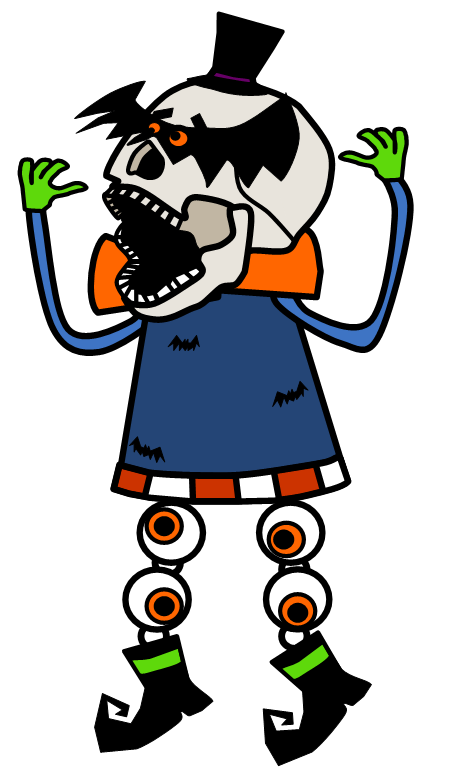
By Alpaca Stew!
HALLOWEEN 2012 ARCHIVE: