Written by Jonathan Wojcik
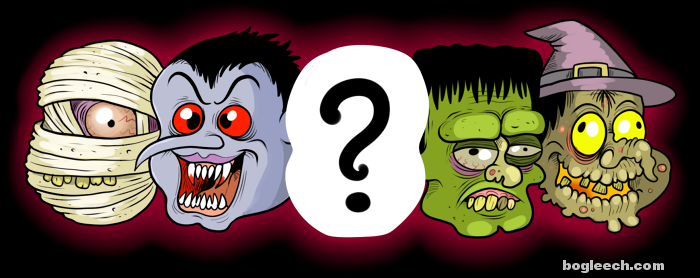
October 30: BOGLEECH.COM'S TOP SIX HONORARY HALLOWEEN MASCOTS
For generations, a central set of famous monsters have been the figureheads of Halloween; Dracula, Frankenstein's monster, the mummy, the wolfman, witches, ghosts, the grim reaper and a few other privileged ghouls appear again and again in Halloween costumes, decorations, toys, cartoons, television specials, candies and more. Yes, this is largely due to some wildly successful film roles, but there are several other characteristics making these particular beings such fundamental monsters in our minds. Each has an iconic, universally recognized appearance established at some point by popular culture - Bela Lugosi's cape, Boris Karloff's neck bolts, the Wicked Witch's warty green nose - and all have a dash of the supernatural as well, either animated by or in control of forces beyond normal scientific understanding. Perhaps most importantly, every monster we associate with the season has a certain human element. Yes, I do enjoy my tentacled space parasites and insectoid mutants, but I do recognize the significance of such anthrocentric monsters as vampires, zombies and ghosts...they're fundamentally creepy to us because they are us. They parody our inevitable deaths and exaggerate the darkness and violence buried somewhere within all of us.
Also, it's really easy to make costumes of person-shaped things.
So, what am I getting at with all this exposition? After what I swear were weeks of objective deliberation, I've narrowed down six cultural figures that I believe best fit the same criteria as the monsters we most closely associate with the Halloween season. There are monsters out there I personally love more than some of these guys, but these are the six coolest monsters that I could realistically envision becoming mainstream seasonal mascots; the six that just "work" for the same special reasons as wolf people, cloaked skeletons and dead guys with gauze on them.
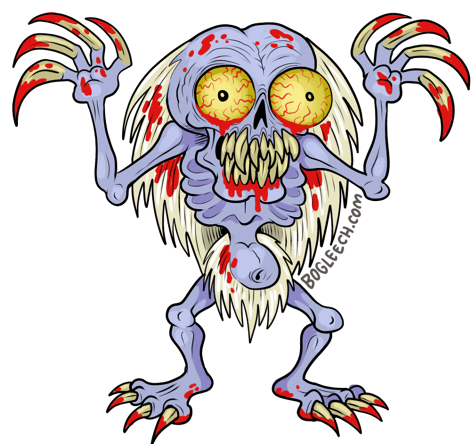
#6: The Wendigo
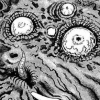
Poorly understood in modern popular culture, this Native American figure was believed to be a human who resorted to the terrible taboo of cannibalism, transforming into a ravenous, icy spirit of winter famine. They were most commonly described as pale, terribly emaciated human figures, their extremities blackened by frostbite, their lips gnawed away by their own filthy fangs. Sometimes they were said to be covered in thick hair, and are in some modern portrayals interchangeable with the abominable snowman or Yeti. Some legends describe tremendous, owl-like eyeballs oozing with blood, while others portray them with dim lights in deep, black sockets. In a few stories, the creatures are themselves comprised of ice and snow.
Ideally, the Wendigo wouldn't catch on as a mainstream Halloween mascot because there's a lot of things not at all right with corporations commercializing native folklore, but I've already seen "Wendigos" in horror movies, video games and yes, Halloween costumes more times than I can count...and the vast majority are just absolutely butchered. More often than not, they're just portrayed as "werewolves, only worse." What about the emaciated ice-giant with the huge, bleeding eyes? There's no mistaking that for anything else. If you're going to rip these things off, at least get them partially right.
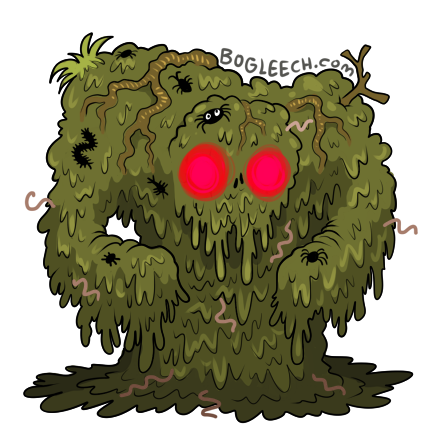
#5: Swamp Monsters
There's really no authentic "mythology" or traditional lore behind the concept of a "swamp monster," yet for many people, the phrase immediately calls to mind a hulking, oozing humanoid mound of decaying, mossy muck; a shambling, living mass of pure swampiness. Such beasts have appeared in innumerable cartoons, comics, films and games, including characters like The Heap, Swamp Thing and Man-Thing. Despite how rarely they're recognized as a distinct "species" of monster, a striking majority of these globsters share a very similar origin story: they represent humans who perished in a swampy environment and became one with their surroundings as they decomposed, a transformation often facilitated by a magical hex, cosmic forces or man-made pollution.
There's little that needs to be said here. A humanoid made of dripping, green gunk speaks for itself as an icon of horror. To really catch on it would be best to play up their aspects as a form of "undead," possibly with the power to transform other people into swamp monsters with the mere touch of their infectious muck. Making a swamp monster costume is as easy as draping yourself in tattered green and brown fabric, adding vegetation (real or plastic) and insects (preferably plastic) with a little glue.
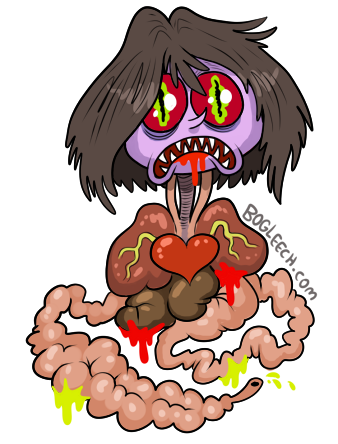
#4: The Krasue, Penanggalan, Leyak and others
For centuries, the diverse cultures comprising Southeast Asia have all had their variations on the same disturbing creature; a bodiless, levitating head, usually female, with its intestines and other innards dangling from its neck. Sometimes ghosts, sometimes witches, sometimes simply monsters, these floating parasites all share a thirst for the blood of the living, especially infants and even the unborn. In many legends, they may return to their original bodies and live as normal women by day.
Perhaps the American Halloween market still isn't ready for gummi candies or plush toys shaped like eviscerated women, but these gutsy ghosts are massive cultural phenomena in their native lands and too striking a visual for us to keep ignoring. It would be nice if the core Halloween creatures had some women other than just nondescript witches or the other monster's hot wives. A Penanggalan or Krasue costume would be easier than you might think; like the traditional spandex skeleton costume, the body could be obscured in black fabric with colorful organs printed on or hung from the neck.
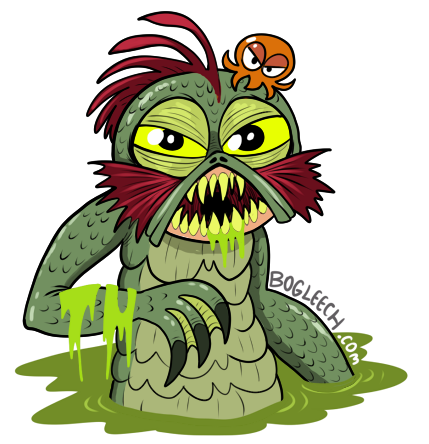
#3: Fish People
The Gill-Man or "creature from the black lagoon" is already one of the most famous Universal monsters, yet somehow never took off as a "generic" monster to anywhere near the extent of his cinematic brothers. In the rare case that a humanoid fish is represented for Halloween, it's virtually always an official, licensed Gill Man appearance or close imitation thereof. Even that only happens when he's part of a set with the other famous monsters, and even that's only if they had the extra room. Where are all the original, generic fish-people this time of year? Why didn't they ever go as viral as Bela Lugosi's Dracula or Boris Karloff's Frankie? Personally, I blame the absence of that "supernatural" element I mentioned earlier. The other monsters all have either terrible powers, immortality or both, whereas poor Gill-man is basically a very strange but easily killable animal. He's awesome, but he's not really morbid, and morbidity is the first thing we look for in our Halloween ambassadors.
Conveniently, fish people go back far beyond the Black Lagoon and already achieve supernatural status on multiple occasions. Stories of them pepper ancient culture around the world, many of them associated with ancient sea gods, magic or even the souls of drowned men, and while I do feel the works of H.P. Lovecraft lost a lot of their novelty in recent years, his deep ones drip with a disturbing, otherworldly atmosphere, fell into the public domain long ago and pre-date the Gill Man by at least twenty years. I could easily see this wide array of fishy fiends hybridizing into a single multi-purpose icon, a human transformed by some terrible sea-demon's curse into a scaly, slimy killer.
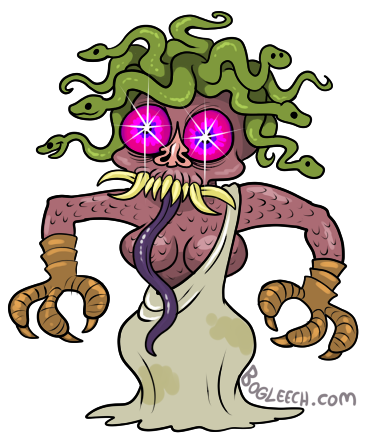
#2: Gorgons
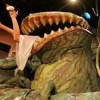
Already making rare and sporadic appearances as Halloween costumes, modern gorgons are unfortunately mere shadows of their former ghoulishness. Yes, it's pretty cool to have live snakes for hair, but there's so much more to them than...this. The original Greek gorgons were three sisters known as Euryale, Stheno and Medusa, of which only poor Medusa could be killed. All men who looked upon their faces were instantly transformed into solid stone, in some tellings by the sheer unimaginable hideousness of their faces. The gorgons were sometimes said to possess brass claws, feathery wings, serpentine scales, boar-like tusks and huge, slimy tongues too long to even fit into their mouths.
Sexy chicks with snakes on their heads certainly have their place, but I'd like to see more of Medusa as a real monster. A horrendous monster. You can keep the nice cleavage, that's cool, but how about those metal claws and big, gross tusks? At the very least, Medusa should have both snakes for hair and monstrous eyes, since it's her gaze that's often specified as petrifying her victims. No, not sexy cat-woman eyes. Show me Medusa with penetrating, lidless, hideously bulging reptilian eyeballs. As I already mentioned, women sorely need more options when it comes to scary famous monsters, and a killer-eyeball snake woman would perfectly round out the Universal monster gang. I'm really surprised there was never a successful Medusa movie to establish her alongside Dracula, only her one notable (and magnificent) appearance in the original Clash of the Titans.
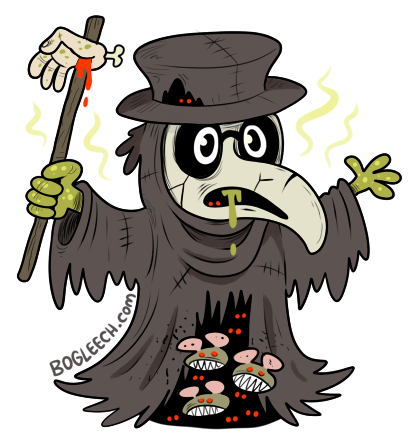
#1: Plague Doctors
"Wait!" You say, "your top choice isn't even a monster! It's just a guy in a funny costume!" Well, yes, but isn't it the same case with witches? And unlike witches, we have tangible evidence that these people actually existed exactly as they're remembered today. Rarely legitimate medical professionals, plague doctors were once hired collectively by entire towns or cities to tend to victims of the black death, and were often distinguished by a sort of primitive "gas mask," the hollow beak packed with fragrant herbs to protect against the "evil smells" plague was falsely attributed to. These ominous figures dated from the fourteenth to sixteenth century, and became widely feared as harbingers of death during one of the darkest periods of the past thousand years.
Eerie to behold and completely ineffective at healing the sick, it doesn't take a big leap to exaggerate these real world figures into monstrous entities, perhaps twisted and maddened by disease into something a little less than human. Their bizarre appearance would fit in beautifully alongside October's other creeps and weirdos, their historical roots amping up their fear factor in ways a werewolf can only dream of. Disease is a far more real and terrifying threat than any poltergeist or demon, and a theme sorely lacking from the traditional spooky rogue's gallery.
Fortunately, this is one that really does stand a chance at infiltrating Halloween commercialism; plague doctor appreciation seems to have been on a steady increase over the past few years with more and more appearances in video games, comics, manga and even cosplay. Could child-size plague doctor costumes be in Wal-Mart's future? Historical hipsters might disagree, but god I hope so.
Browse Halloween 2011: