Amazing Cephalopods
  Squids, cuttlefish, octopuses (the correct plural) and their kin are among the most advanced forms of life on our planet, and include the world's most intelligent invertebrates as well as the world's largest.
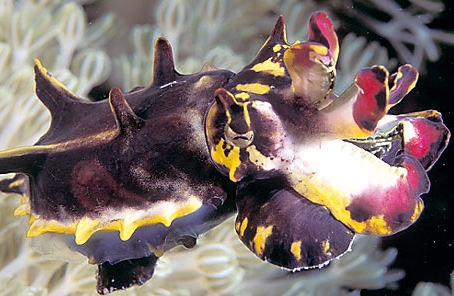
The aptly-named "Flamboyant Cuttlefish"
- Hypnotic Tentacles -
  Cuttlefish (relatives of squids and octopuses) are so adept at changing color that many species can send differently-colored bands "flowing" up and down their bodies. This mesmerizes fish and shrimp until the mollusc ensnares them in its two longer tentacles, which shoot out like the tongue of a chameleon.
- Walking Coconut -
  Some octopuses have been observed wearing the shells of sunken coconuts as armor. The octopus will "walk" along the seabed by the tips of its tentacles with one half of the coconut suspended beneath its body and the other half on top of its head, pulling in and closing the shells tight at the first sign of danger.
- Caped Crusader -
  Females of the genus Tremoctopus react to predators by unfurling an immense, colorful membrane from their tentacles that trails like a flag as they retreat. Predators are much more likely to attack this fragile cloak than the octopus' vital parts, and they are quickly discouraged by mouthful after mouthful of the tasteless film. Male tremoctopus are less than 1% the size of females, and mate by filling one of their own tentacles with sperm before ripping it off and presenting it to the female. He will die shortly thereafter. Females have also been observed pulling tentacles off the venomous Portuguese Man O' War and carrying them as defensive weapons.
- Eight-armed Brains -
  The octopus is believed to have the most advanced mind of any invertebrate animal, demonstrating complex problem-solving skills, individual personality, emotion and curiosity. In captivity, they learn quickly to solve puzzles and navigate mazes, they have been shown to memorize the faces of human handlers, and they seem to enjoy toys... especially small, colorful floating objects that they can pull under water and release again and again. Their learning capacity is limited only by their short lifespan; a few months to three years depending upon species.
- The Mighty Kraken -
  Mesonychoteuthis hamiltoni, the Antarctic "colossal" squid, is believed to be the largest invertebrate in the world, with an estimated maximum length of nearly 50 feet; several feet longer than the famed "giant" squid, Architeuthis dux. The colossal squid also differs from the giant squid in having large, swiveling "hooks" on the suckers of its club-like tentacles, resembling the talons of a predatory bird. Its eyes are the largest in the entire known animal kingdom.
- Shapeshifter -
  The colorful and graceful "mimic octopus" boasts some of the most elaborate defensive maneuvers in nature. To confuse both predator and prey alike, it contorts its semifluid form into the shapes of entirely different sea creatures, changing its color and behavior accordingly. They have been observed copying seahorses, stingrays, jellyfish, squid, starfish, crabs, lionfish, and more. Above are examples of sea-snake and flounder mimicry.
- Stealth Hunter -
  The deep-sea Jewel Squid (Histioteuthis) has a left eye much larger than the other other. It hangs in the water with the large eye staring upwards in search of prey and the smaller eye watching for attackers from below. The squid gets its name from the tiny lights that speckle its entire body. These lights are adjusted throughout the day to effectively camouflage the squid against what little light filters down from the sea's surface.
- Light Screen -
  Heteroteuthis dispar is a three-inch squid with extremely large eyes (among nature's largest in proportion to body size) and is unique among squid for having luminous ink, which confuses and blinds most deep-sea predators. The only other deep sea animal known to have such an ability are the tube-shoulders, a group of otherwise normal-looking fish that can emit glowing fluid from a tiny pipe above each gill.
- Envy of Chameleons -
  Nothing in nature boasts camouflage as advanced as that of the common octopus, which can control not only the coloration of its skin but also the texture, shifting from smooth to warty in the blink of an eye. It can even bunch its skin into a "hairy" or "leafy" appearance, blending with marine vegetation.
- The Firefly Squid -
  Every year from March to May, Japan's Toyama bay comes alive with an intense, sparkling blue glow that can light up the sky. The culprit is the three-inch "firefly squid", Watasenia scintillans, millions of which congregate in the bay to mate. Their bodies are speckled with tiny, blue photophores, and they possess a set of larger lights on their tentacle-tips to lure prey. They are considered one of Japan's national treasures.
- A Living Chandelier -
  Stauroteuthidae, a genus containing only two species, are a highly unusual webbed octopus family with boomerang-shaped internal shells and rows of tiny lights where other species bear suckers. Flanking the lights are double rows of hair-like sensory filaments, probably used in hunting. They sometimes joins the tips of their tentacles and "inflate" their fleshy webbing, taking on a balloon-like shape. The purpose of this behavior is unknown.
- Invisibility -
  Many deep-sea cephalopods have completely transparent bodies to camouflage themselves in the water, but some of their organs, especially their eyes, are still opaque and actually appear darker to most predators than the surrounding void of the deep ocean. To compensate, these ghostly mollusks possess tiny lights around their visible organs, just bright enough to blend their features with the faint light of the abyss.
- Catches Fish, Just Like Flies -
  Too new to science for a proper name, the eerie creature above has been nick-named the "spider squid", and is unlike any other squid known to man. Its ten identical arms (as opposed to the usual eight arms and two whips) have a curious "elbow" near the head that the animals holds stiff, and trail off into stringy tendrils up to twenty feet long that may ensnare passing fish like a sticky web. The fins on its mantle are proportionately the largest of all Cephalopoda.
A Grimpoteuthis or "Dumbo Octopus" from the deep sea. Roughly the size of a grapefruit.
Back to Bogleech.com
All images were gleaned from news articles and may or may not have been authorized for public use. If you are the original photographer and would like content credited or removed,  e-mail me