Insects & Other Arthropods
The Spiny Devil Katydid, Panacanthus Cuspidatus.
- Cockroach Charmer -
  Ampulex compressa is a species of predatory wasp that feeds its larvae on living cockroaches many times the adult wasp's size. To accomplish this, the mother wasp injects her venom in just the right place to disable the victim's escape instinct. Without a sense of self-preservation, the roach submits blindly to the wasp as she guides it straight into her nest of hungry grubs.
- Enemy Within -
  Solenopsis daguerrei is a species of ant that has taken on a parasitic lifestyle. It has no worker or soldier class and exists only as reproductive males and females. The females attach themselves to the queens of black or red fire ants, disguising themselves with the scent of the host colony and laying their eggs alongside the host queen's. The young will be fed and protected by the fire ants until they mature and seek out other colonies to invade.
- Glowing Spider-Worms -
  Larvae of Arachnocampa luminosa (the New Zealand fungus gnat) hang from cave ceilings and glow brightly to attract moths and other flying insects which are trapped in the maggot's dangling mucus strands and hauled up to be eaten. One particular cave is a famous attraction for the millions of worms hanging from its ceiling like a galaxy of stars. Adults also glow, but live only a few days and lack mouths.
- Man-eater -
  In some species of firefly, the female may mimic the mating signals of other species and devour the males she attracts.
- Almighty Tallest -
  Some kinds of fruit flies have a very comical mating ritual; two males face eachother, stand up on the tips of their hind legs and stretch out as high as they can. Whichever fly can put its front claws overtop the other's wins the female.
A Common Housefly inflating its head to break free of its pupa.
- Silent Takeover -
  Another form of parasitic ant is Lasius umbratus. After mating, the queen lands outside an established ant colony and hunts for one of their workers, which she will kill to obtain the host colony's odor. She will enter the nest undetected, kill the queen, and take her place. The host colony will tend to this imposter queen and her eggs until every original worker and soldier has died naturally...leaving only a colony of Lasius.
- Ghoulish Romance -
  The male and female burying beetle (or gravedigger beetle) meet at dusk over the corpse of a small bird or rodent and spend the entire night digging out a pit in which they bury themselves and the entire body. They will (appropriately enough) remain in this grave for the rest of their short lives, tending to their grubs with the corpse as a food suply. The parents will die together just when the young will be able to fend for themselves.
- A Cheap Date -
  During mating, certain carnivorous "dance flies" capture live insects and cocoon them in silk to present as gifts to females. Sometimes, however, an inadequate and desperate male cocoons a twig, leaf or pebble. By the time the female figures out his trick, the male has finished mating with her and made his escape.
- Walking Bombs -
  Camponotus saundersi is a malaysian ant species with the incredible defensive behavior of self-destructing. Two oversized, poison-filled mandibular glands run the entire length of the ant's body. When combat takes a turn for the worse, the ant violently contracts its abdominal muscles to rupture its body and spray poison in all directions.
- Big Bad Wolf -
  Lacewing larvae prey primarily on aphids, but many aphids are protected by ants who enjoy the aphid's secretion of honeydew (a sugary, liquid waste product). To get by the ant "shepherds", the spiny, grublike larva coats itself in the discarded shells of aphids or in the fuzzy white "wool" that some aphids are coated with. The ants, who's primary senses are touch and smell, cannot tell the difference between the disguised lacewing and a live group of aphids.
- Big Bad Wolf -
  Ants of the genus Polyergus are fierce, powerful insects so geared towards fighting that they do not know how to feed themselves. They depend entirely on ants of the genus Formica, which Polyergus keep as slaves. Formica workers, stolen right from their own colonies, are forced to perform all non-combative duties in the Polyergus nest including excavation and rearing young. Without any slaves, an adult Polyergus can starve to death surrounded by food.
- Magnetic Shoes -
  The feet of a spider aren't merely "sticky", but are covered with intricately branching bristles called setules. The tip of a single foot can bear hundreds of thousands of these setules, which react with electrons to create an attraction between surrounding molecules. This is the force that allows a spider to easily climb any surface.
Genetically mutated fruit flies - one with a misshapen, four-eyed head and one with two wings on the same side.
- Glue Gun -
  The Velvet Worm (Peripatus), is a long, soft-bodied carnivore with a snail-like head and dozens of feet resembling the suckers of a caterpillar. Neither a worm nor an insect, but an ancient insect ancestor, this slow-moving forest dweller has a special method of subdueing insect prey. From glands to either side of its mouth it squirts dual streams of a sticky, transparent fluid that hardens almost instantly on contact with air. It ripples the strands back and forth like twin lassos, perfectly entwining the prey from afar. It liesurely approaches and feeds on the helpless victim with its sharp mandibles, which do not act in coordination.
- Morbid Curiosity -
  One variety of assassin bug sits at the entrance of a termite nest with dead termites attached to its back. Worker termites who come to investigate the bodies are impaled on the bug's sharp beak to be sucked dry and added to the lure.
- Foster Home -
  One species of tropical caterpillar lives in the nests of stinging ants. The caterpillar secretes sweet, delicious honeydew that encourages the ants to keep it alive and healthy. When the caterpillar hatches from its pupa as a butterfly, the ants even escort it out of the nest and protect it until its first flight.
- Web Spitter -
  The Spitting Spider is the only spider with silk glands in both its head and abdomen. These glands work in conjunction with its venom sacs to spray poisonous silk from its fangs. In cartoons and horror films, of course, any spider can do this.
- Killer Caterpillars -
  Certain tropical inchworms are actually predatory, posing as a twig or leaf until another insect gets too close. They are the world's only known carnivorous caterpillars. Some Hawwaian caterpillars prey upon snails, wedging their silken casing under the victim's shell and tying it down with silk to feed at the insect's liesure.
- A Foul Defense -
  The larva of the tortoise beetle covers itself in a protective "basket" of its own feces, resembling a bird's nest, which forms in an outward spiral as the insect defecates. This protects it from most predators but not from the carabid beetle, who's elongated head is specially adapted for reaching into the tangled mess and devouring the sluggish little grub.
- The Living Room Carpet: A Savage Jungle of Death -
  Males of a certain predatory mite have giant, crushing mandibles while the females have rhinoceros-like "horns". The males use their jaws to herd dust mites to where the female can impale them. Another dust-mite hunter is a fat, barely mobile mite that hides itself in piles of rubbish; when another mite passes by, it spits out a long strand of gooey saliva, like the tongue of a chameleon, and reels in its prey.
- Barbed Wire -
  Polyxenus millipedes are tiny, stubby, hairy little creatures with an ingenious defense mechanism; at the tail end are two large tufts of fine bristles lined with hundreds of tiny hooks. If an ant or other predatory insect comes too close it gets a faceful of these strands which become instantly and firmly entangled in the limbs, hairs and spines of the attacker like a velcro net. The insect may even remain tangled until it starves to death.
- Helpful Hitchhikers -
  Some rove beetles ride in the fur of mice or other mammals and feed exclusively on ticks. Others cling to the backs of ants or termites and defend them against winged attackers.
A spider of the group Gasteracantha.
- Tough Love -
  Discovered in 2000,  Madagascan "Dracula Ants" feed on the blood of their own larva, scratching them open and drinking just enough to sustain themselves without killing the young. Larva themselves eat food brought by the workers, but have been observed running and hiding when an adult enters their chamber.
- Unusual Earwigs -
  Arixeniina earwigs are eyeless, wingless, hairy, lack pincers (males have only a set of short pegs), and live exclusively on or around bats, feeding on dead skin flakes or guano. They give birth live. Another group of earwigs, Hemimerina, are louse-like parasites found only on the bodies of giant african pouched rats.
- Torture Rack -
   Allomerus decemarticulatus ants have been found to construct incredibly elaborate traps to capture large prey. From plant fibers and fungus, they fashion a hidden platform covered in holes just large enough for their heads. When a long-legged insect accidentally steps in one of the holes, it is instantly bitten and held fast by an ant. Eventually it is stretched tightly across the platform by several sets of tiny jaws, as other ants pour forth to dismember it.
- False Mate -
  Larvae of the blister beetle Meloe Franciscanus are parasites in the nests of solitary bees where they feed on nectar, pollen, and sometimes eggs. To enter the nest, a group of larvae form a cluster on the tip of a leaf or twig and mimic the shape, color and smell of a female bee. When a male attempts to mate with this cluster, several larvae attach to him. As soon as he locates a real female bee, the larvae jump ship and are carried back to her nest.
- Bloodsucking Spider -
  As discovered only recently, the african jumping spider Evarcha culicivora is the first known spider to feed on the blood of large mammals, which it obtains by attacking freshly-engorged mosquitos. This also makes it the first known predator to choose prey by what it has recently eaten.
- Slime Dweller -
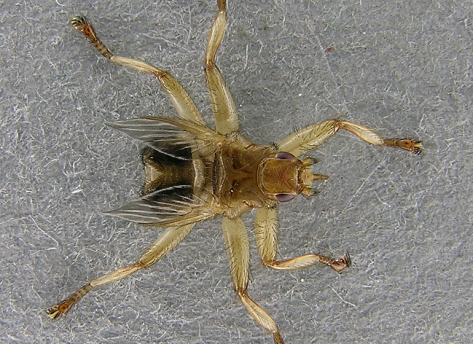
  One species of wingless phorid fly can be found only on the bodies of giant African land-snails. The flies are not parasites, but feed harmlessly on the slime of their host.
- Spider Hive -
  Theridion nigroannulatum is currently the first truly social spider ever discovered. Found in the rainforests of Ecuador, they build communal webs and work together to overwhelm larger insect prey.