The Abyss and the Ceratioid Anglers
|
Here, the very weight of the water would implode a human body with up to
11,000 pounds of pressure, temperatures drop as low as two degrees celsius
and no form of plant life can grow. In the late 1800's, naturalist Edward Forbes
declared that life could not possibly exist below 540 meters - less than 2,000
feet - sparking controversy that lasted decades.
Today, we know that life is not only possible at these tremendous depths, but
that it flourishes like nowhere else on Earth. Human eyes have seen less than a
millionth of this alien environment, but the volume and variety of its known fauna
are staggering and ever-growing. More species dwell in this freezing void than
in any sunny reef or steamy jungle, and the bizarre forms they take to survive in
these conditions could put many a science fiction artist to shame. You can read
even more about the abyss itself - with more profanity! - in my Cracked topic
page on the subject.
Written by Jonathan C. Wojcik - Most images by Theodore Pietsch from tolweb.org - images are used under a creative commons license.
|
13,000 feet beneath the surface of the sea begins what is known as the Abyssopelagic or Abyssal
zone, a black and icy void that the rays of our sun cannot penetrate.
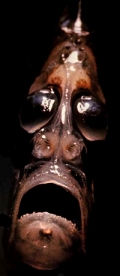
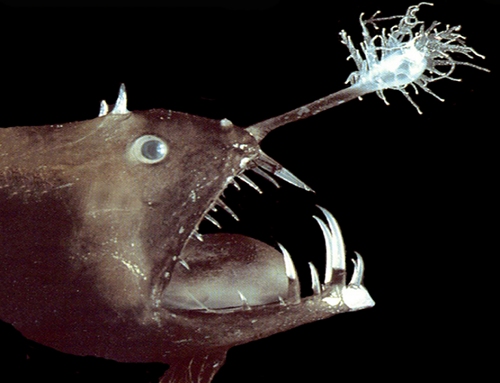
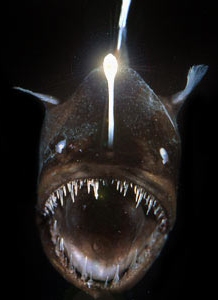
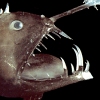
The quintessential abyss-dwellers are the the Ceratioidei, "deep sea anglerfish" or "sea
devils," most famous for the brightly glowing lures or esca on the end of movable "fishing
poles" or illicium, modified from what would be the first bony rays of a dorsal fin. This
contraption is typically waved over their mouths, attracting other fish who mistake the
glowing tip for small prey. With over-sized jaws, hinged teeth and highly elastic stomachs,
the devils are prepared to blindly attack anything their bait might bring them, sometimes
swallowing prey several times their own size. Strange though these qualities may seem,
they are usually unique to the females of this group - while males are even stranger.


With sophisticated senses but an atrophied digestive system, a tiny male Ceratioid
cannot survive for long on his own, existing only to sniff out a female in the perpetual
darkness. On locating a mate, he digs his beak-like jaws into her flesh where he will live
parasitically for the remainder of his days. An enzyme melds together the skin of the two
lovebirds, their circulatory system becomes one and the male will lose virtually
everything not used in reproduction, including most or all of his head and brain.
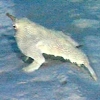
Even within these unique animals is a great deal of more extreme variation. The "hairy"
anglers, family Caulophrynidae, have fins that extend into sensitive feelers for detecting
movement in the water.
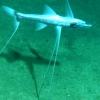
Members of another family, the Gigantactinidae or "whipnose" anglers, have lures of
extraordinary length, with one six-inch species sporting a whip over six feet long.
Especially strange is that these fish typically swim upside down, with the whip dangling
towards the sea floor.
Perhaps the oddest anglers of all are the Thaumatichthyidae or "wolf trap" sea devils,
whose massive upper jaws fold in half lengthwise, like the leaves of a Venus fly trap, to
cage the prey before it is sucked into the throat. They are divided into genus Lasiognathus
and genus Thaumaticthys. Lasiognathus species like these two bear the most
cartoonishly perfect "fishing rods" of any anglerfish, complete with bony hooks. Since
anglers don't normally allow prey to bite their precious lures, the purpose of the hooks is
unknown. They may simply make the lure look larger and more enticing, though it has been
postulated that they are used to grab the tentacles of squid or other soft-bodies prey.


Genus Thaumatichthyis differs from Lasiognathus or any other angler with a lure that
reaches down through its upper jaw to dangle directly in its gaping mouth, with a small
"window" on the bulb itself that can adjust its brightness. They are much more benthic than
other Ceratioids, meaning they are most at home on or near the sea floor, and have oddly
enough been found with decayed plant matter and sea cucumbers in their stomachs,
implying omnivorous scavenging habits in addition to predation.
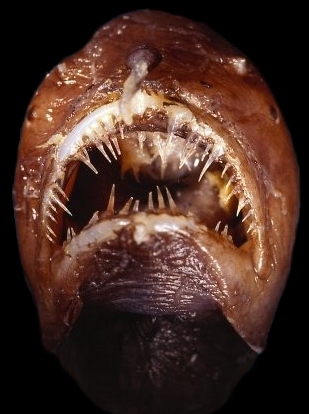
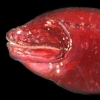
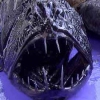
While there are certainly many more fascinating Ceratioids in the deep, the last one I'll be
introducing you to is Neoceratias spinifer here, the only member of the Neoceratiidae. This
highly divergent angler has stopped angling altogether, lacking any trace of a lure or the
ability to produce light. Its sleek body as adapted towards more traditional, active hunting,
and its face full of hook-tipped, movable teeth makes a wicked trapping mechanism even
without a lure.
A Thaumaticthys in its only animated appearance, courtesy Spongebob Squarepants.
|