
Written by Jonathan Wojcik
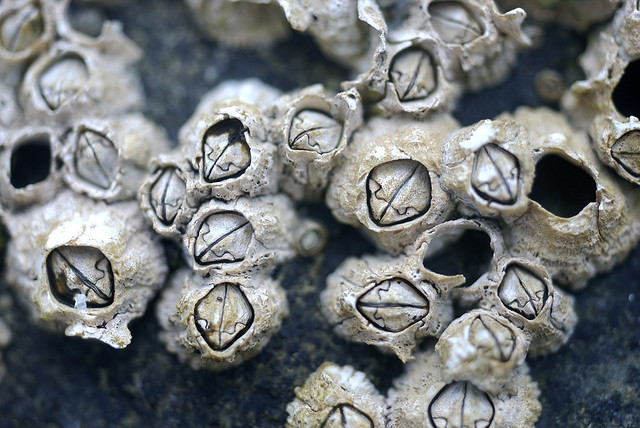
Of all the sea-life we can view with the naked eye, the barnacles or Cirripedia are simultaneously among the most plentiful and the most overlooked. They gradually build up on almost any submerged object, the tell-tale fingerprints of the sea's briny clutches. Seldom do people stop to realize that these crusty little lumps, peppered over every rusty anchor and waterlogged pier, are just a whole bunch of incredibly bizarre bugs. Crustaceans, specifically; just like crabs, lobsters and shrimp.
"Acorn" barnacles like the ones above are usually the barnacles that first spring to mind,
and to begin our understanding of these weirdos, we're going to go over how an acorn
barnacle develops. From there, we'll take a look at progressively more peculiar features of
the group.

Like all Crustaceans, Cirripedia begin their lives as microscopic plankton. The first stage,
characterized by a single eye, is called the Nauplius, and is a form shared by virtually all
Crustaceans at some point in their development, whether as a larva or in early embryonic
stages.

After up to six months as a Nauplius, the barnacle begins to deviate from other
Crustaceans by becoming a Cyprid. This stage is enclosed in a clam-like set of hinged
shells, and it exists only to seek out a resting place; a rock, a seashell, a whale, another
barnacle, anything solid will do, though most species will follow pheromone trails and
settle alongside their own kind. Once it finds a suitable location, it secretes an adhesive
from its antennae and anchors in place upside-down.
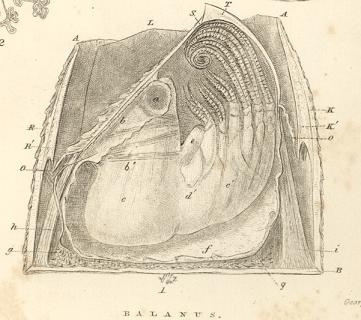
On the outside, our barnacle will rapidly grow into the armored fortress we all know and love, but on the inside, it still follows a shrimp-like body plan. Our squishy bug will spend the rest of its life rooted inside its spacious exoskeleton, employing its feathery legs as a net to collect plankton and other nutrients from the water's current. Layers of its own natural "cement" keep it firmly adhered as it grows, one of the strongest attachment compounds found in nature.
Of course, reproduction can be a bit of a problem for animals that don't move around.
Some, like the corals and sponges, solve it by pumping sperm and eggs into the water.
Some just clone themselves. Acorn barnacles are a little more sophisticated than that; as
arthropods, they're more complex animals with an anatomy closer to you or I than to a
coral polyp. What I'm saying is that barnacles have penises, and since they can't walk
around, they have really, really long, prehensile penises.
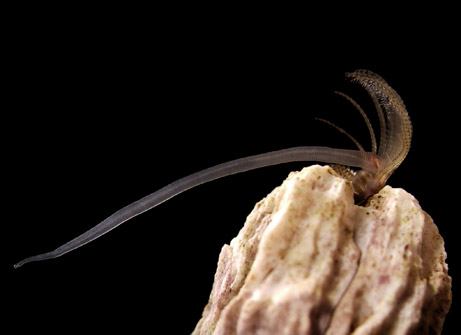
WwwwoooooooOOP!
The penis of the barnacle is in fact considered one of the largest proportionate members in the entire animal
kingdom, allowing the creature to simply reach over and fertilize its neighbors. To
add to the convenience, all acorn barnacles are hermaphroditic, so each individual
can both conceive and bear young.

Simple acorn barnacles take on many different shapes and sizes for different environments; these hexagonal pits are just the tops of large barnacles embedded deep in the skin of a whale, painless and harmless to the titanic sea mammal as they filter food from water passing over its body. These in turn provide a home for whale lice, another harmless hitchhiker and fellow crustacean related to skeleton shrimp.

Excavated whale barnacles - Source

Slightly odder than the acorns are the stalked or "goose" barnacles, many of which prefer to grow on floating objects such as seaweed, driftwood, boats or lengths of rope. These barnacles are so named not merely for their appearance, but for the bizarre medieval-era misconception that they were the eggs or young of actual geese. This was so readily accepted that goose flesh was recognized as "fish" by the Catholic church, and thus acceptable to eat on a Friday when red meat and poultry were forbidden.
Unlike acorn barnacles, some goose-necked species have two distinct sexes, but adult
males may be little more than tiny tubes of sperm, attached to the larger females or even living within their shells.


On more than one occasion, goose barnacles have been mistaken for "sea monsters" when
thousands congregated on a single object such as this length of rope, unrecognizable beneath their squirming bodies.

Not content to depend on passing flotsam, "buoy" barnacles secrete their own flotation device from buoyant, foam-like cement, riding the current of their own volition like a Portuguese Man O' War.

These little surfer bums may merge together with others of their kind, and these communal rafts may in turn pick up other species of barnacle! In a sense, these barnacles have taken an evolutionary step back towards mobility - could full-fledged swimming be next?

Whatever they attach to, nearly all barnacles attach to objects that either don't move at all or move slowly enough for those tiny little cyprid larvae to get a comfortable grip; it's one reason you don't see barnacles attached to most speedier little fish or shrimp. A startling exception exists, however, in the genus Xenobalanus, which can be found exclusively on the fins of dolphins and other porpoises including the mighty orca. At a distance, they might look like rows of slimy, black leeches, and up close, you might assume they're related to some of the stalked barnacles we just looked at, but no! These are actually another type of acorn barnacle, but one that evolves a long, soft shape. This makes them "pseudostalked" barnacles, since they don't have a true flexible stalk like their goosier cousins.

Xenobalanus still don't qualify as "parasites," since they don't feed on their host, but their attachment mechanism doesn't look like a fun time at all. Their star-shaped base is lined with hundreds of tiny teeth, and digs deeply enough into the host's flesh that they leave a killer six-lobed scar behind when they finally die and drop off. It's the only way they can remain attached as their hosts jet through the water at up to 20 miles an hour, which may not sound like much to us automobile-driving anthropomorphs, but under water, it's a pretty intense current the barnacles have to endure, and it really is incredible that they aren't yanked off. It's even more incredible that they ever get there in the first place, and I don't believe their larval stage has even undergone much study to determine how they pull off such a feat!

You already recognize acorn barnacles, but the softer, pinker tubes hanging off of these specimens are Conchoderma auritum, goose barnacles of a group sometimes known as "rabbit ear" barnacles for a pair of soft flaps above their mouths. The remarkable thing about these is that they exclusively attach themselves to acorn barnacles, and exclusively to the acorn barnacles found on whales! They cause harm to neither the whale nor their fellow barnacles, but enjoy all the benefits of whale attachment without having to adapt to the whale's slippery skin directly. The acorn barnacle simply provides a much easier base!

Largely barren of plankton, our beloved abyssal zone is generally inhospitable to
traditional filter-feeders, but some barnacles, such as this beautiful Vulcanolepis species, find their
niche near hydrothermal vents; the boiling, toxic undersea volcanoes where bacteria
thrive like nowhere else on Earth. Rather than catch food from the water, these
guys expose their fuzzy legs to the heat and grow their own personal "crop" of edible bacteria.

Not boring in the "how long will we talk about all these damn barnacles" sense, but boring in
the "tunnels through soft flesh" sense, which is almost the exact polar opposite of the other
type of boring! The drawing above portrays an adult female Lithoglyptis mitis, one of the
Acrothoracica. These extremely tiny barnacles burrow their way into snails, clams or even other
barnacle species to live parasitically, never developing the thick armor of their relatives.
Males are much tinier than females, and may in turn live in or on the bodies of their
mates (the object in the lower right, here).
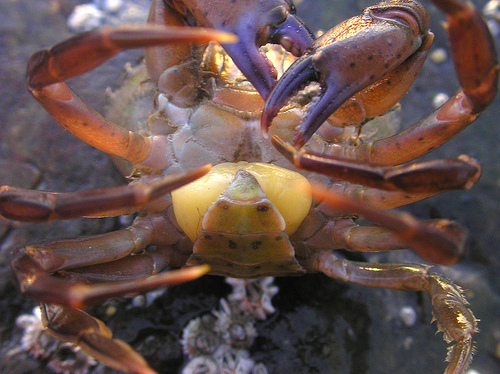
We now come to one of my favorite monstrosities of the deep blue sea; the rhizocephalan ("root head!") barnacles such as those of the genus Sacculina. I talk about these wonders in further detail here, but I could just keep going about them all day.
At that point in life where other barnacles attach to a rock or a sea-turtle, a rhizocephalan cyprid finds itself a crab, inserts a needle-like appendage into the larger crustacean's body and injects a single, tiny clump of cells. This microscopic blob is the beginning of its adult stage, and the rest of its body is discarded. Soon, the parasitic cells grow into long filaments throughout the crab's body, even invading its eyes, and it's no surprise that these
organisms were once mistaken for a type of fungus. They metamorphose into what is more or
less crab cancer, and they only get weirder from there, manipulating their host in downright
disturbing ways. If you haven't already, go read all about it. Our other barnacles can wait; they are sessile, after all.

Sacculina are favorites of mine and definitely among the strangest animals I've ever known, but if you're having trouble relating to the plight of a crab, here's a barnacle that parasitizes some of your own vertebrate cousins; small sharks (dogfish) of the deep sea abyss. Many
other barnacles may attach to larger animals, as we've seen, but generally only as harmless hitch-hikers feeding from the surrounding water. Anelasma squalicola is an exception, and you're looking at one deeply anchored in a shark's back.

Rees 2014: doi:10.1016/j.cub.2014.05.030
Here we have an anatomical comparison between A. squalicola and one of its closest relatives, a more ordinary goose barnacle. You can see how the long legs typically used to collect food are atrophied inside its shell, and can't even reach outside of it at all. The stalk, meanwhile, has evolved into a fleshy bulb that anchors alarmingly deep within the shark with a multitude of short roots, steadily draining nutrients from the surrounding tissues. They may actually attach almost anywhere on the host body, and it's even common to find them crowding in the shark's nostrils, lips and eye sockets, all around the edge of the shark's eyeballs. Like the unrelated rhizocephalans, they castrate their host, which is actually fairly routine for the parasites of invertebrates. It is not routine for vertebrate parasites, and in fact, this is one of the only parasites in the world that deliberately renders a vertebrate infertile. This is likely because life in the abyss can be a life of fairly infrequent meals, and the barnacle would prefer its tasty host to not waste any nutrients on reproduction.

In 1835, Charles Darwin collected a tiny parasite from the shell of a conch, a creature very similar to one of the boring barnacles. It intrigued him, but would be filed away for over a decade before he would finally settle down and examine it. At the time, barnacles were understood quite poorly, and had even been considered mollusks only years prior.
Darwin affectionately nicknamed his discovery "Mr. Arthrobalanus" or "Mister Jointed Barnacle," began comparing its anatomy to various other barnacle species and intended to spend a few months studying the animals before returning to the subject of natural selection. Instead, faced with a wealth of unexplored territory and pressured by colleagues, barnacle research would consume the aging naturalist for eight grueling years, his health severely deteriorating as he spent day after day dissecting and comparing thousands of specimens from all over the world, living and fossilized, before completing four entire volumes on barnacles alone.
Through these studies, Darwin found answers to many of his deepest questions on the processes of adaptation, and to this day, this writing is among the most extensive and valuable research ever devoted to a single animal group. The discovery of Mr. Arthrobalanus - whom Darwin would later dub Cryptophialus - was almost certainly one of the most life-changing and influential finds of the man's entire career as a naturalist, and Darwin allegedly had this to say on the matter:
"I hate a Barnacle as no man ever did before."

Where's your god now?